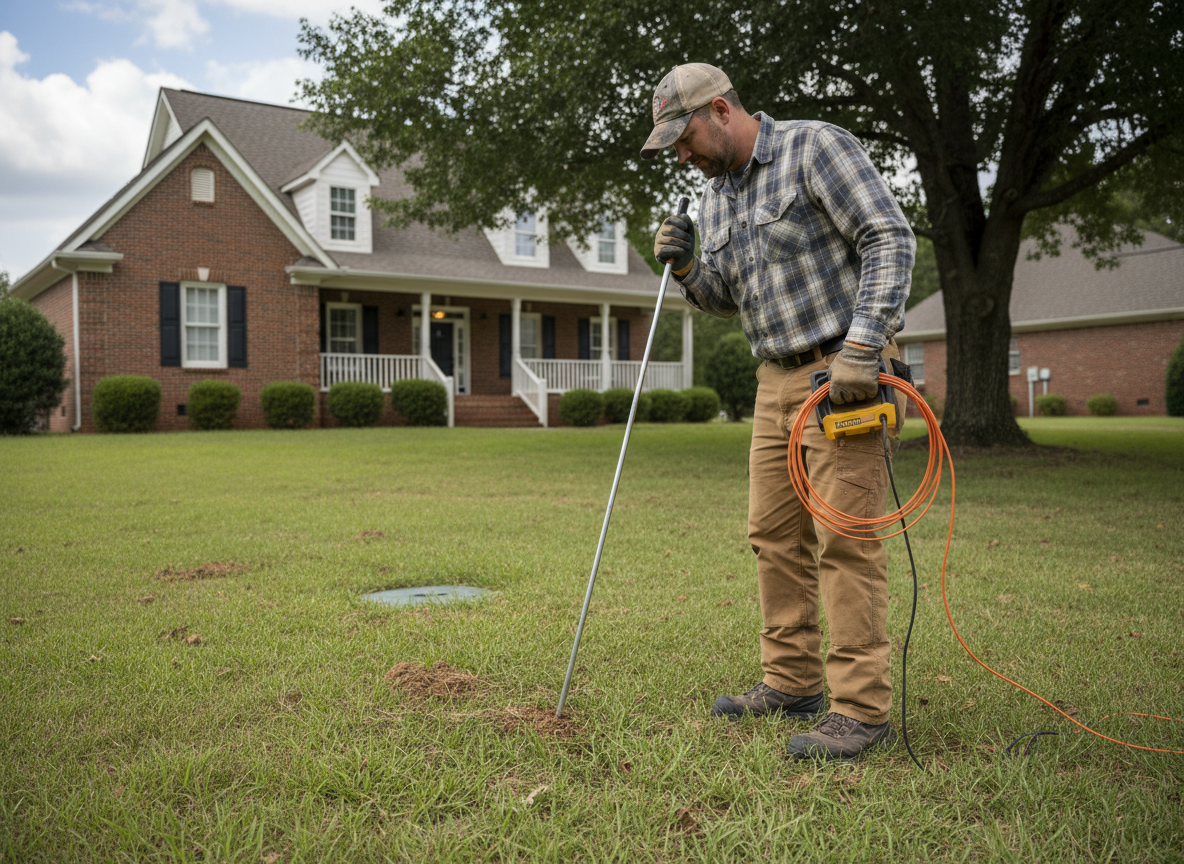
In Asheboro neighborhoods from North Asheboro to rural lots along Deep River and US-220, locating a septic tank starts with checking property records and walking the yard for clues like lush grass strips or slight depressions. Heavy rain in the humid subtropical climate often saturates Piedmont red clay, making tanks harder to find when water pools or shifts the ground. We probe methodically around the house foundation, inlet lines from the home, and outlet paths toward the drain field, watching for the concrete lid or risers that older original tanks in Randolph County commonly lack.
Rocky Uwharrie soils near Seagrove and Lake Lucas add resistance when pushing probes, so we adjust angle and depth rather than forcing through stones that could damage equipment or miss the tank edge. Tree roots from mature oaks frequently wrap around baffles and inlet tees on these lots, so we trace the sewer line from the house cleanout while checking for gurgling or sewage odor that signals a shifted tank. On properties off I-73/74 or NC-49, we also scan for distribution box locations because heavy rain events can mask the tank under saturated soil.
Newer subdivisions around the North Carolina Zoo and Asheboro Amtrak Station sometimes have tanks placed farther from the home due to lot grading, requiring a systematic grid search with an effluent filter check once the lid is exposed. We note pump chamber float switches and aerobic system components during location because those features change how the tank sits relative to the drain field. Every job ends with marking the tank clearly so future pumping avoids guesswork on these variable rural sites.
Technician insight
In Asheboro the thing that catches most people out with locating a septic tank is assuming it sits right next to the house like newer builds. On older rural lots off sewer the tank is often twenty or thirty feet out because of how the original installer had to work around the red clay and slope toward the drain field. Heavy rain makes the ground soft so probes sink unevenly and you can miss the lid by a foot if you do not go slow.
North Asheboro Lot With Hidden Tank
Homeowner called after noticing sewage odor near the back fence following heavy rain. We reviewed old lot notes, walked the yard, and probed through saturated clay until we located the tank twenty-eight feet from the house under a low spot. The lid was cracked and tree roots had grown across the outlet tee. We exposed the tank, cleared the roots, installed a riser, and marked everything so the next pumping would be straightforward.
Locating a Septic Tank Services We Offer
✓Probe and Locate Service
We use steel probes and electronic locators to find buried tanks on red clay and rocky lots without unnecessary digging.
✓Camera Inspection During Location
Once the tank is found we run a camera through the inlet and outlet lines to check baffles and confirm pipe alignment.
✓Riser and Lid Installation After Location
After locating an older tank we install risers and lids so future access stays easy on rural Asheboro properties.
✓Drain Field Connection Mapping
We trace lines from the located tank to the distribution box and drain field to identify any saturated sections caused by heavy rain.
✓Effluent Filter Check and Cleaning
During location we inspect and clean the effluent filter to prevent backups before they reach the home.
How it works
- 1
Review Property Records
We start by checking available septic permits and lot diagrams for the address to narrow the search area on Asheboro and Randolph County properties.
- 2
Walk The Site And Probe
Next we walk the yard looking for visual clues then probe the soil in a grid pattern, adjusting for red clay and rocky Uwharrie conditions.
- 3
Expose And Verify Tank
Once we hit the lid we carefully excavate enough to confirm the tank type, check baffles, and note any tree root interference.
- 4
Mark And Document Location
We mark the tank clearly on the surface and provide a simple diagram so the homeowner knows exact placement for future service.
Pricing
Cost for locating a septic tank depends on tank size, how deep it is buried, ground conditions, and whether the access point is already clear or obstructed by landscaping or structures.