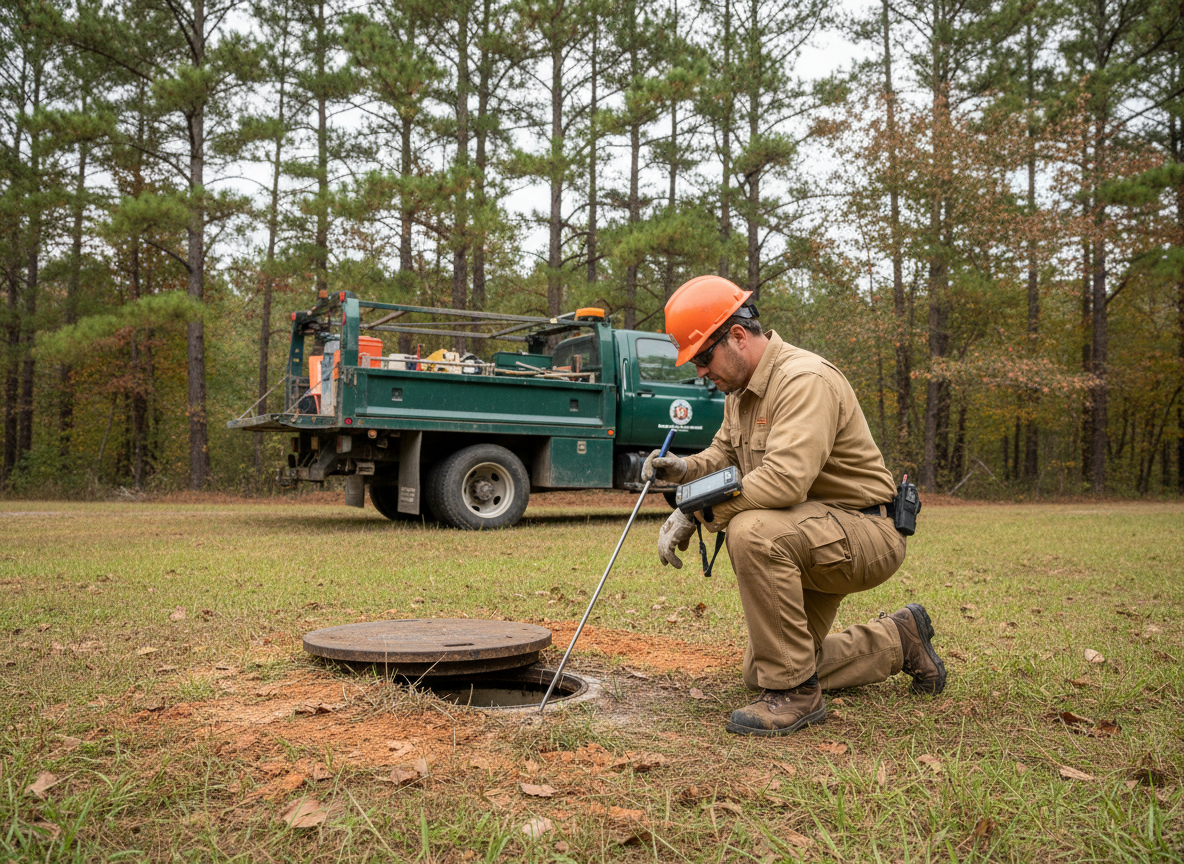
On rural lots off sewer around North Asheboro and near the Uwharrie Mountains, older original tanks often sit under heavy vegetation or driveways where access is tight. We locate the buried tank by probing the ground and checking for the distribution box, then open risers or lids to look inside. Heavy rain events common in the humid subtropical climate can push water into the tank or saturate the surrounding Piedmont red clay, so we note any signs of recent overflow or root intrusion from nearby trees that block inlet and outlet tees.
Inside the tank we measure sludge and scum layers with a sludge judge and inspect the effluent filter for clogs that reduce flow to the drain field. In rocky Uwharrie soils the drain field trenches can shift or collapse over time, so we check the distribution box for even flow and look for standing water or sewage odor that signals a saturated field. Gurgling toilets or slow drains often trace back to a failing baffle or float switch in the pump chamber, which we test by running water and watching the alarm trigger points.
After heavy rain we pay extra attention to aerobic systems and pump chambers on lots near Deep River or Lake Lucas because clay holds moisture and can mask early backup problems. We trace the outlet line to see if effluent is reaching the field evenly and note any tree roots that have cracked pipes or lids. Homeowners on NC-49 or US-220 corridors frequently overlook these details until sewage backs up into the house, so our inspection records exact measurements and photos for future reference.
Technician insight
In Asheboro, the thing that catches most people out with Septic Inspection is older original tanks on rural lots where Piedmont red clay holds water after heavy rain and the drain field looks fine from the surface until a backup hits. Homeowners often forget to check the effluent filter or whether tree roots have reached the outlet tee.
North Asheboro Lot After Heavy Rain
The homeowner noticed gurgling drains following several days of rain on a rural lot off US-220. We located the tank and found the effluent filter clogged with solids while the distribution box showed uneven flow into one line. The saturated Piedmont clay around the drain field was the cause. We cleaned the filter, recommended pumping and advised monitoring the field during future wet periods.
Septic Inspection Services We Offer
✓Baffle and Tee Inspection
We open the tank and examine inlet and outlet baffles plus tees for cracks or displacement that allow solids to reach the drain field.
✓Effluent Filter Assessment
The filter is removed and cleaned on site while we check for buildup that restricts flow from the tank to the distribution box.
✓Drain Field Evaluation
We probe the field lines and distribution box to detect saturation or uneven flow caused by Piedmont red clay or rocky Uwharrie soils after heavy rain.
✓Sludge and Scum Measurement
Layers inside the tank are measured to determine when pumping is needed before solids migrate into the drain field on rural Asheboro lots.
✓Riser and Lid Inspection
Existing risers and lids are checked for proper sealing and accessibility so future pumping and inspections stay straightforward on older tanks.
How it works
- 1
Locate The Tank And Components
We use probing rods and site knowledge to find the buried tank, distribution box and drain field lines on the rural lot.
- 2
Open And Inspect The Tank
Risers or lids are removed so we can measure sludge and scum, examine baffles, tees and the effluent filter.
- 3
Check The Drain Field
The distribution box and field lines are examined for even flow, standing water or signs of saturation from local clay soils.
- 4
Document Findings
Measurements, photos and observations are recorded so the homeowner understands the current condition of the system.
Pricing
The cost of a septic inspection depends on tank size, access and condition.