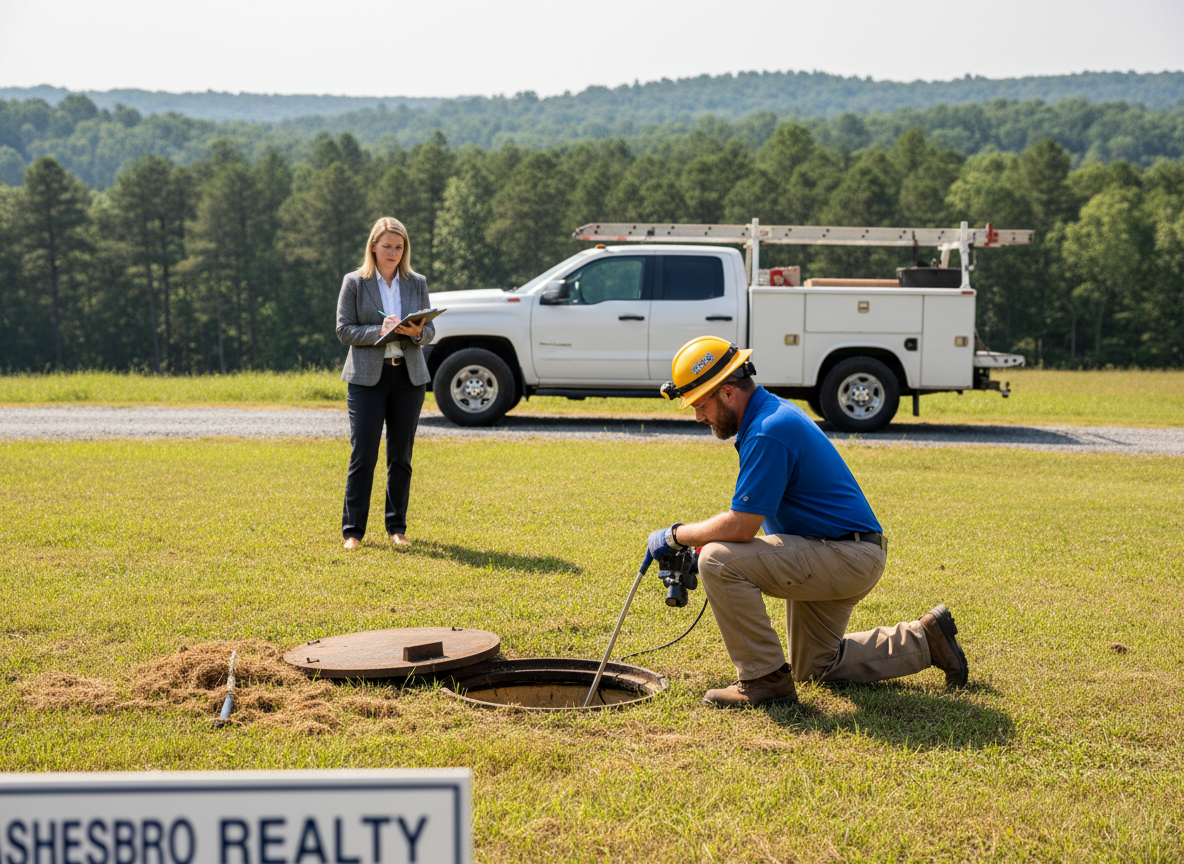
On rural lots off sewer around Asheboro, we start by locating the buried tank and checking for signs of backup or sewage odor near the house. Heavy rain in the humid subtropical climate often saturates the drain field, so we probe distribution box outlets and look for standing water or gurgling in lines. Older original tanks common in North Asheboro and along US-220 frequently show heavy sludge and scum layers that have built up against inlet and outlet tees.
We remove risers and lids to inspect the effluent filter and pump chamber float switch, especially on properties near the Deep River or Lake Lucas where tree roots push into joints. In rocky Uwharrie soils we trace the drain field lines by hand to confirm they remain open rather than compacted by clay. When an aerobic system is present we verify the aerator and alarm still function before any real estate closing.
Access matters on lots along NC-49 or I-73/74 where newer subdivisions sit on septic. We map every component, note any garbage disposal load that has increased solids, and document whether the distribution box is level. After the inspection we return the site to its original condition so the property shows cleanly for buyers touring from Greensboro or Lexington.
Technician insight
In Asheboro the thing that catches most people out with Real Estate Septic Inspection is how Piedmont red clay holds water after a heavy rain and saturates drain fields on rural lots near the Uwharrie Mountains. Homeowners often assume an older tank is fine until we open it and find roots or a shifted distribution box that only shows up during a sale.
Older Tank on Lot Near Seagrove
The sellers needed the system cleared before closing. We located the tank on a wooded rural lot, pumped it, and found the outlet tee blocked by roots with the drain field holding water in the red clay. We cleared the line, confirmed the distribution box was level, and documented everything so the buyer could proceed without delay.
Real Estate Septic Inspection Services We Offer
✓Tank Interior Inspection
We open the tank and measure sludge and scum layers while checking baffles and inlet outlet tees for damage common on older Asheboro properties.
✓Drain Field Assessment
Probes and visual checks determine whether Piedmont red clay or heavy rain has saturated lines or created pooling near the distribution box.
✓Effluent Filter and Riser Check
Filters are removed and cleaned while risers and lids are examined for cracks that allow roots or debris into the system on rural Randolph lots.
✓Pump Chamber Evaluation
Float switches, alarms and pump function are tested on aerobic and pump-equipped systems found in subdivisions off US-64 and NC-49.
✓Site Access and Location Mapping
We locate buried tanks on wooded or sloped lots near the Uwharrie Mountains and mark all components for the buyer and closing agent.
How it works
- 1
Site Walk and Tank Location
We walk the property to find the tank, note nearby wells or drain fields, and check for obvious sewage odor or wet areas.
- 2
Access and Pumping
Risers are opened, the tank is pumped if needed, and interior walls plus components are exposed for inspection.
- 3
Component Testing
Baffles, tees, effluent filter, distribution box and drain field lines are examined for function and signs of failure.
- 4
Documentation and Report
Findings are recorded with photos and notes on soil conditions, access difficulty and any repairs observed.
Pricing
The cost of a real estate septic inspection depends on tank size, access and condition.