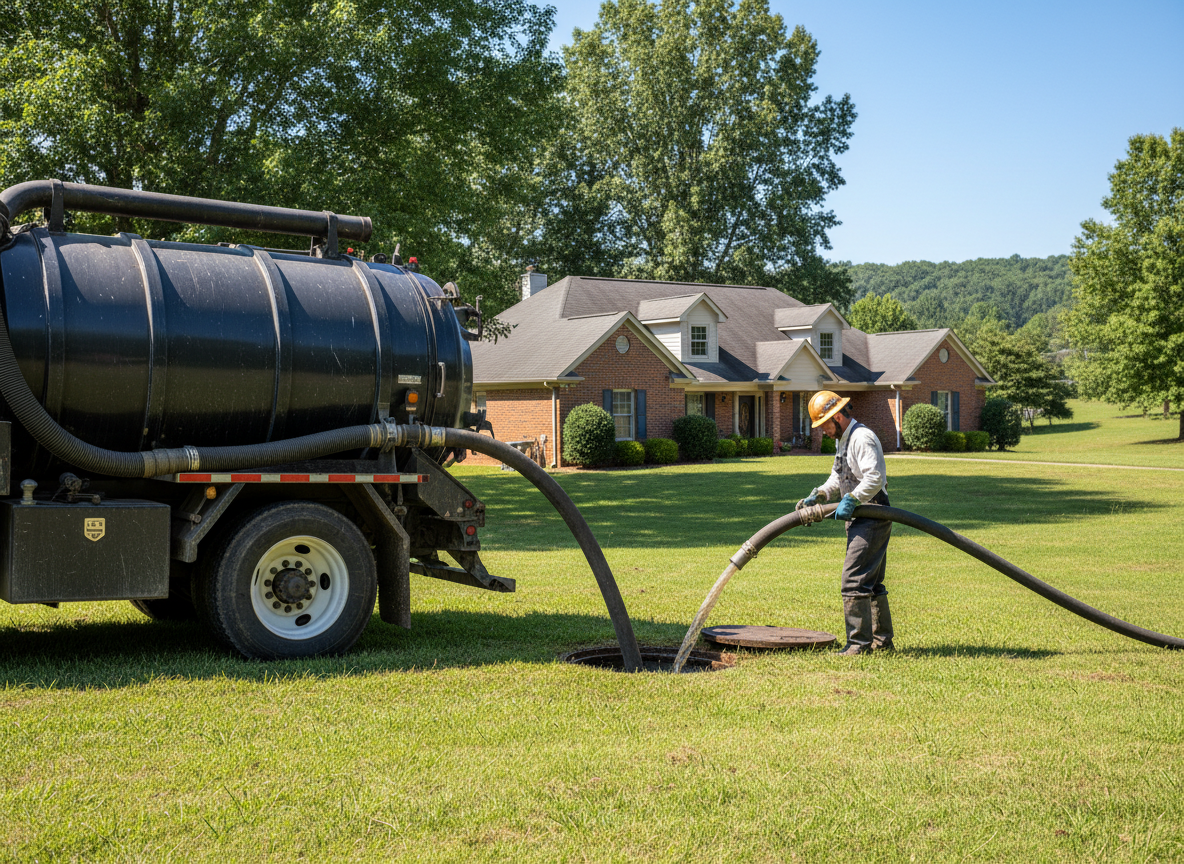
On rural lots off sewer in North Asheboro and around the Uwharrie Mountains, septic tanks often sit under heavy Piedmont red clay that holds water after storms. We arrive to find older original tanks with thick sludge and scum layers built up from years of use, plus newer subdivision systems where garbage disposal loads speed up solids accumulation. Heavy rain events common in the humid subtropical climate push effluent toward the drain field, so we note any gurgling in lines or sewage odor near the distribution box before opening the tank.
We locate buried tanks using probe rods and check inlet and outlet tees for damage or blockage, then pull the effluent filter to clean trapped solids that could clog the drain field. In rocky Uwharrie soils near Seagrove or along Deep River, roots from nearby trees frequently invade the tank or pump chamber, so we inspect float switches and risers for proper function. Every job includes measuring sludge depth and confirming the distribution box routes effluent evenly before closing lids.
Access challenges appear on properties near Lake Lucas or off NC-49 where driveways are narrow and tanks sit under patios or landscaping. After pumping, we verify baffles remain intact and note any saturated drain field conditions caused by repeated heavy rains soaking the clay. Homeowners in Downtown Asheboro and along US-220 often discover the alarm on aerobic systems has been ignored until backup occurs, so we test all electrical components before leaving the site.
Technician insight
In Asheboro the thing that catches most people out with septic tank cleaning is how quickly Piedmont red clay and heavy rain events saturate the drain field on older rural lots. Homeowners assume a simple pump fixes everything, yet we regularly find tree roots from Uwharrie soils cracking baffles or blocking the outlet tee. Checking the distribution box and noting effluent levels before we leave prevents the next backup that shows up after the next storm.
Older Tank on North Asheboro Lot
A homeowner off US-64 reported gurgling drains after heavy rain. We located the buried tank, pumped the thick sludge layer, and found the outlet tee displaced by roots. New baffles were fitted and the filter cleaned before restoring the site. No further backups occurred once the saturated field had time to recover.
Septic Tank Cleaning Services We Offer
✓Baffle and Tee Inspection
We examine inlet and outlet baffles plus tees for cracks or displacement that allow solids into the drain field.
✓Effluent Filter Cleaning
Filters are removed, rinsed and reinstalled to prevent premature clogging of the distribution box and laterals.
✓Pump Chamber Service
Float switches, pumps and alarms in chambers are tested after solids removal to keep aerobic and standard systems operating.
✓Riser and Lid Installation
New or existing risers are fitted with secure lids to simplify future access on lots where tanks are buried deep in clay.
✓Drain Field Assessment
We check for ponding, odors and slow drainage around the field after pumping to catch saturation early.
How it works
- 1
Locate and Expose the Tank
We use probes and maps to find the tank on rural Asheboro lots, then remove lids or install risers for full access.
- 2
Pump Out Sludge and Scum
Contents are removed completely, including the layers that accumulate faster in systems serving homes with garbage disposals.
- 3
Inspect Internal Components
Baffles, tees, filters and the distribution box are checked for damage while noting any root intrusion from nearby trees.
- 4
Restore Site and Record Findings
Lids are secured, the area is backfilled, and homeowners receive notes on soil conditions and any needed follow-up.
Pricing
The cost of septic tank cleaning depends on tank size, access difficulty, and overall condition of the system.